As of October 2026. Updated with the EU AI Act deadlines that have applied since August 2026 or have been postponed.
Doctors spend a large part of their working time on documentation: dictating findings, writing doctor's letters, maintaining patient records. At the same time, the waiting room is full of patients hoping for as thorough a consultation as possible. How can artificial intelligence help here at all?
The answer requires an honest look at what is possible today, what the GDPR and the EU AI Act require, and where doctors need to be careful.
Where AI genuinely helps today
The most useful AI applications in a medical practice are not the spectacular ones, but tools that reduce the administrative burden.
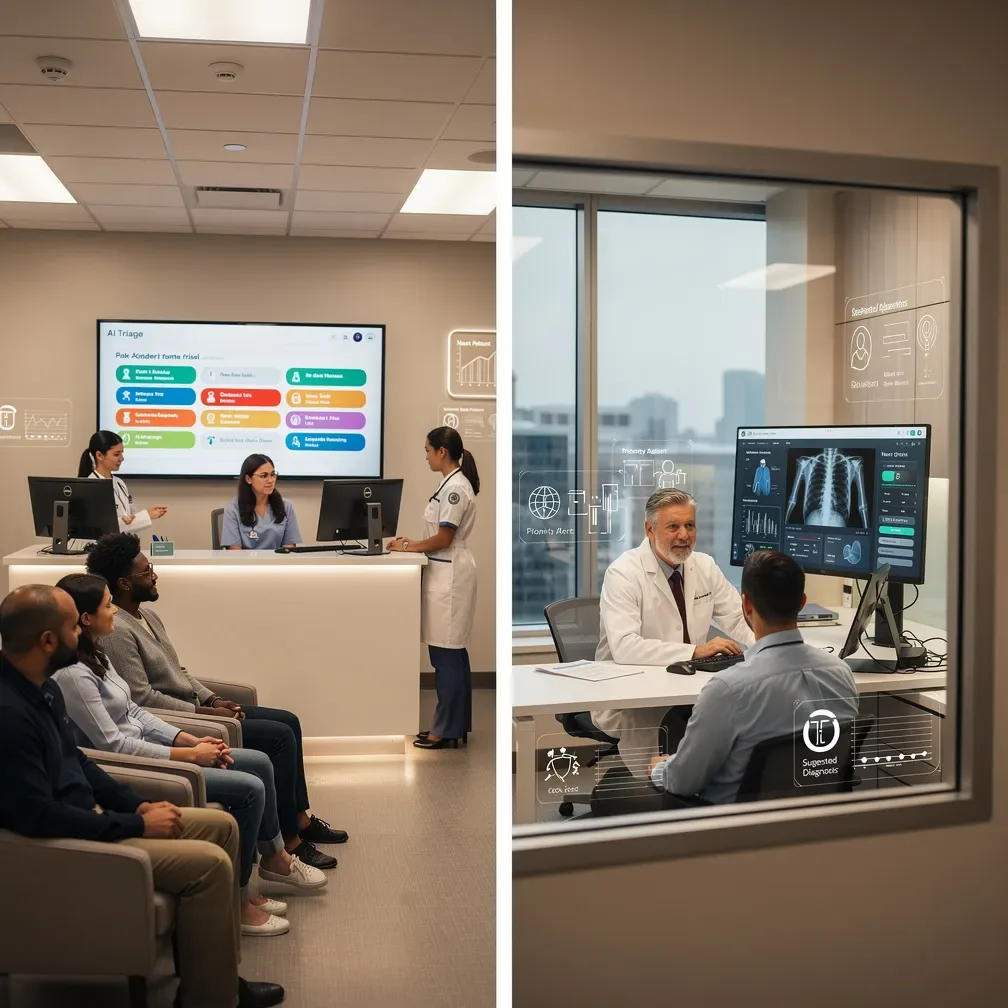
Documentation: AI-supported systems transcribe the doctor-patient conversation in real time. The software recognises medical terminology, structures what was said into history, findings and plan, and passes the result to the practice management system. The doctor reviews, corrects and approves. The write-up after each consultation turns into a short check. This now also works with local models, where the data never leaves the practice.
Preparing findings: Scanned doctor's letters, external findings and lab data can be read automatically, assigned to the right patient and summarised. The AI does not replace the medical assessment. But it provides a clean basis on which that assessment can be made faster.
Patient communication: Automated email drafts, appointment booking, reminders. Not exciting, but in a practice with 80 appointments a day a real time saver. Since 2 August 2026, a chatbot or appointment assistant that communicates directly with patients must be designed so that they know they are talking to an AI (more on this below).
Exam preparation and continuing education: AI can serve as a study partner that asks specialist questions, explains answers and gets to the heart of complex relationships.
What AI cannot do
One clear limit up front: AI does not replace a medical diagnosis. A large language model, however well trained, generates text based on probabilities. Models keep improving and now have memory functions and internal correction mechanisms. But a sound diagnosis still needs a doctor in the end.
Three specific weaknesses that matter in everyday practice:
AI hallucinates: It invents facts that sound plausible but are wrong. In a blog post that hardly shows. With a medication or a dosage it can become dangerous. Every AI-generated document must therefore be checked.
AI does not know current guidelines: The training data of most models ends months before today. The AI does not know new studies, changed dosage recommendations or updated guidelines. It can of course be fed current data, for example through a RAG system, but that data is only ever as current as the last update. Connecting it to web search does not solve these problems either, especially when the medical context requires access to studies and specialist publications.
AI does not understand context: A model processes what it is given. If a patient mentions in passing that he sleeps badly, that could be overlooked. An experienced doctor might recognise an important clue in it and take different steps. Models are currently learning to deal with this problem, but you should not rely on their results and suggestions alone.
The data protection problem: bigger than you think
Health data is among the most sensitive data there is. The GDPR classifies it as a special category of personal data (Article 9). That has concrete consequences for using AI in a practice.
Where is the data processed? Anyone who has a patient conversation transcribed by an AI system sends highly sensitive information to a server. The key question: where is that server? The GDPR only allows transfers to third countries such as the US under strict conditions. If the answer is "unclear", the use cannot be justified. For health data, the server should therefore be located in the EU, without exception. It is even better to rely on local models from the start, at least where that is possible. Running a language model as large as ChatGPT or Claude locally would require a data centre (quite apart from the fact that this is not possible at all for some models). So it is best to check during the analysis whether smaller models would suffice, ones that can run on the practice's own hardware or on its own server.
Data processing agreement (DPA): Mandatory under the GDPR. Without a DPA with the AI provider, no processing may take place. Many doctors already use ChatGPT or similar tools. If that happens without a DPA, without a data protection impact assessment and without informing patients, it is a breach of the law, even if it is not yet being checked across the board.
Patient information and consent: If AI is used for documentation, patients must be informed about it. Whether an application also requires explicit consent depends on the specific use. Clarify this with your data protection adviser before you start, especially for applications that touch on diagnostics or treatment decisions.
The EU AI Act: what applies as of October 2026
The EU AI Act has been in force since 1 August 2024 and takes effect in stages. In July 2026 the EU amended it with Regulation (EU) 2026/1744, the so-called Digital Omnibus. According to consistent analyses, it was published in the Official Journal on 24 July 2026 (EUR-Lex, overview). Four points matter for medical practices:
- AI literacy: The AI literacy obligation (Article 4) has applied since 2 February 2025. According to initial analyses, the Omnibus reworded it: instead of ensuring a sufficient level of literacy, deployers take measures to promote AI literacy (analysis). The obligation remains. Train your team, including your practice assistants, and document it.
- Transparency: The transparency obligations under Article 50 have applied since 2 August 2026 (RTR, text of Article 50). A chatbot or appointment assistant that communicates directly with people must be designed so that they are aware of it. This obligation falls first on the provider of the system. Ask anyway whether your product meets it.
- Grace period: There is only one, and it concerns providers. Generative AI systems that were already on the market before 2 August 2026 must add machine-readable marking of AI-generated content (Article 50(2)) by 2 December 2026. All other transparency obligations apply without a transition period.
- High-risk systems: These obligations have been postponed, to 2 December 2027 for stand-alone high-risk systems under Annex III, and to 2 August 2028 for AI in regulated products.
In Austria, the AI Service Centre at RTR provides information on the obligations under the AI Act. It advises, but it is not a supervisory authority.
Local models: the privacy-friendly alternative
As mentioned, there is a way to use AI without sending patient data to external servers. Local AI models run directly on your own computer or on a server in the practice. No data leaves the building.
The downside: Setting them up requires technical knowledge. The models are less capable than the big cloud solutions. And they need powerful hardware.
The upside: Full control over the data. No dependence on US providers. No grey areas in data protection.
For practices that regularly work with sensitive patient data, this is a serious option. The workshops use a combination: cloud models for non-critical tasks (general research, continuing education questions), local models for everything that touches patient data.
Where do Austrian medical practices stand today?
Most practices do not yet use AI systematically. Individual doctors experiment with ChatGPT for findings or doctor's letters. But structured, GDPR-compliant and with a clear governance framework? That is the exception.
The reasons are understandable: lack of time, lack of orientation, uncertainty about data protection and a market full of providers who promise everything. Many colleagues simply do not know where to start.
This is where the workshops come in: developed together with a partner company, they are tailored specifically to doctors. No unnecessary theory. Instead: concrete solutions on site, GDPR-compliant setups and the chance to try out different tools directly.
Six questions every doctor should ask
- Where is the data processed, is the server in the EU, and is it a European provider (even better)?
- Is there a data processing agreement with the provider?
- What happens to the data after processing: is it stored, used for training or deleted?
- How are patients informed about the use of AI?
- Who on the team is trained in using AI, and how is that documented?
- Does the product meet the AI Act's transparency obligations, so that patients can tell when they are talking to an AI?
If a provider cannot answer these questions straight away, caution is advised.
The next step
AI will change medicine too. Doctors who engage with the topic now help shape that change. The others will have to catch up at some point, possibly under time pressure and with fewer options.
If you want to know what getting started could look like for your practice, the workshop concept can be presented in a short conversation.