
A message to all employees, sent as a long German text, only reaches some of the people in a multilingual company. An AI-supported newsletter system prepares every issue, and a Synthesia avatar reads it to employees in their own language. Before anything goes out, the editorial team approves every version. This post describes how such a system is built.
Starting point
When employees speak different first languages and internal news only appears in German and as text, the content reaches part of the workforce poorly. People who speak German as a second language read long texts more slowly or not at all. Translations take time; if they arrive late, the news is already old.
Videos with real presenters solve the language problem, but for a regular issue in many languages they are too much effort: recording, editing and subtitles for every language separately. Without another solution, what remains is a channel that informs but misses many people.
Goal
- Every issue appears in the main languages of the workforce, all at the same time.
- People can listen to and watch the content, not just read it.
- The editorial team stays in control: nothing goes out without approval.
- An issue takes as long as writing it, not as long as a video shoot.
- No personal data of employees goes to any AI service.
The editorial team should keep doing what it does well: choosing news and putting it in context. Shortening, translating and voicing are the system's job.
Architecture
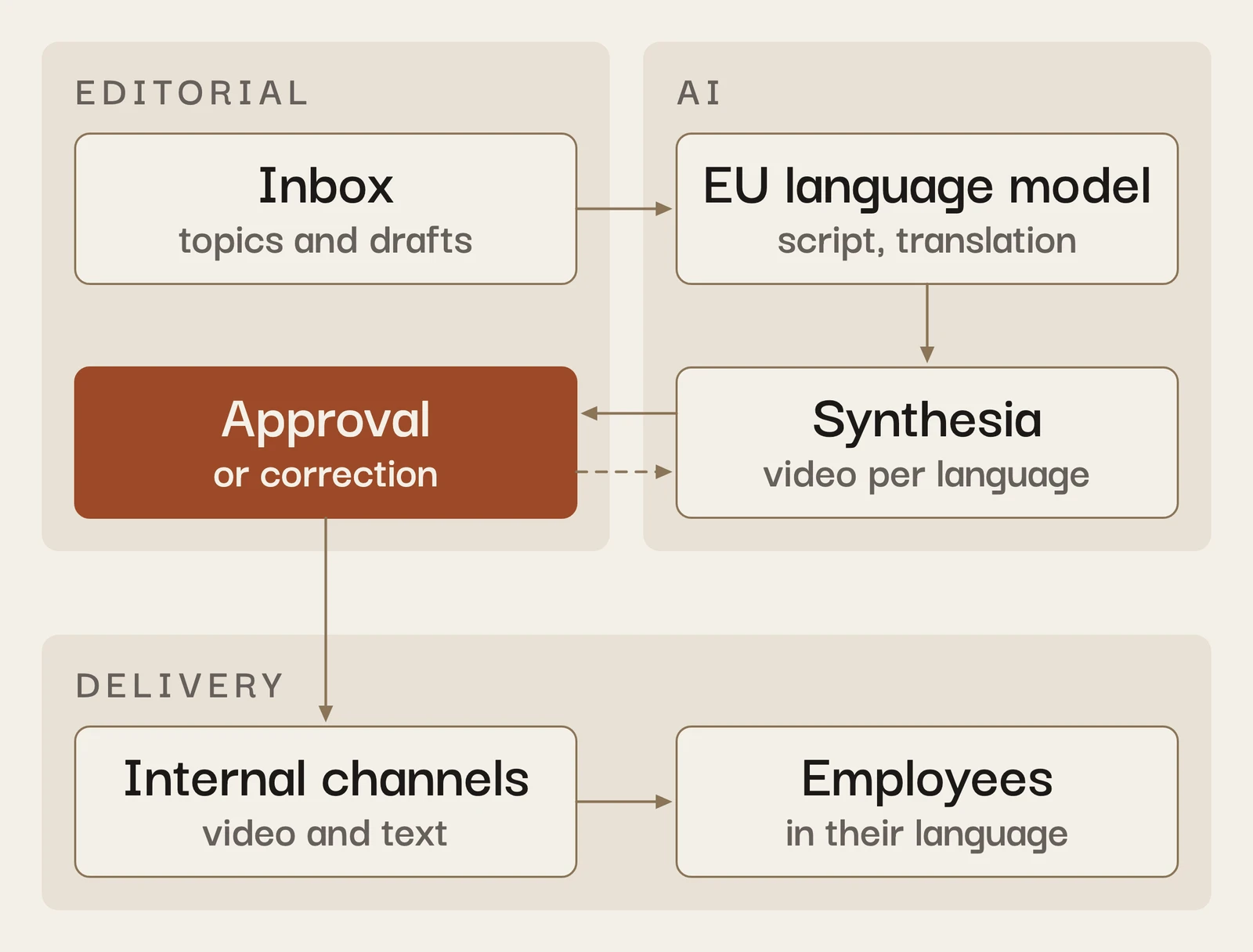
The workflow has five stations. AI works in two of them; the editorial team decides at the approval step.
- Editorial inbox: topics and draft texts from the departments, collected in one place.
- Language model in the EU: cuts the draft to speaking length, turns it into a spoken script and translates it into the target languages. A glossary defines which terms stay untranslated.
- Synthesia (synthesia.io): creates an avatar video in the respective language from each script.
- Editorial approval: before sending, the editorial team checks scripts, translations and videos and approves them or sends them back for correction.
- Distribution: through the internal channels. Each person receives the version in their language, together with the script as text.
Implementation
An avatar video is not an article read aloud. Spoken language needs short sentences, no brackets, no abbreviations and numbers you can follow by ear. The most important prompt in the system therefore writes for listening: one idea per sentence, the key message first, a short video rather than a long speech.
The glossary is the second building block. Department names, product names and internal terms stay the same in every language, otherwise nobody can find the right word anymore. For names the avatar stresses wrongly, spelling them as they sound in the script helps. A mistake that has been fixed once does not come back.
For languages nobody on the editorial team speaks, a back-translation into German serves as a check: if the meaning holds, the version moves on. For sensitive topics, a native-speaking colleague proofreads. To save correction loops, check the script before the video is generated, because changes to text are faster than changes to a finished video.
There are two options for the avatar. A stock avatar from the library is ready to use straight away. An avatar modelled on a real manager feels more personal, but needs that person's explicit consent and clear rules on what it may say. Either way, every video carries a notice that an AI avatar is speaking.
Infrastructure and EU compliance
The principle: only the script goes to the video service. It contains company news, but no data about individual employees. Distribution runs through the company's own systems; Synthesia needs neither recipient lists nor which person gets which language.
Synthesia is based in London. For data transfers to the United Kingdom, an adequacy decision by the European Commission applies. Even so, the data processing agreement and the question of which data centres the service uses belong on the review list before launch, even if only scripts are transferred.
The language model for scripts and translations runs on infrastructure in the EU, for example with Azure OpenAI in EU regions or with Mistral. The same rule applies here: draft texts contain company information, not personnel data. If a name does appear, for example in a congratulation, it only sits in the script that the editorial team approves.
Since 2 August 2026, Article 50 of the AI Act has required deployers to disclose when AI generates image, audio or video content that appears authentic. The label in the video and in the accompanying text meets this. Reach is measured only in total and per language, never per person. That way, the newsletter does not measure the performance of individual employees.
Outcome and value calculation
An issue is produced once and reaches every language group at the same time. The editorial team keeps writing in German; the system creates scripts, translations and videos, and the editorial team checks and approves them. Employees hear the news in their own language, from a face rather than a block of text.
The value calculation has two parts, effort and effect:
- Production savings = issues per year × number of languages × (previous effort for translation and video per language − current review effort per language) × internal hourly rate.
- Costs = video service licence + model usage + editorial time for approval.
- Reach per language = views of the language version divided by employees in that language group, compared with the read rate of the previous text newsletter.
The second part carries more weight. A message that does not arrive costs little to produce and a lot in daily work: follow-up questions, rumours, rules nobody knows. That is why the current read rate should be measured before launch, so that the later comparison rests on real values.
You can find more projects in the overview of reference projects.